
1 Kings 7:23
— The problem of the number Pi in the Bible —
🔼 — 1 Kings 7:23 —
Before we sling 1 Kings 7:23 (and 2 Chronicles 4:2) to the scrap heap, we ought to take a few things into consideration:
🔼Theory versus practice
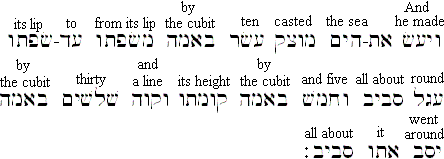
And he made a molten sea, ten cubits from the one brim to the other: it was round all about, and his height was five cubits: and a line of thirty cubits did compass it round about.
The word for cubit is אמה and is identical to the word meaning "mother city". Both words are closely related to the word אם, emma, meaning mother.
In Jeremiah 51:13 it reads, "O you who dwell by many waters, abundant in treasures, your end has come, the cubit of your being cut off."
Isaiah 6:4 reads, "And the cubits of the threshold shook from the voice..."
The famous value of pi=3.1415... is true on a surface that is perfectly flat. On a spherical surface pi is smaller. On a hyperbolic surface pi is not even a constant!
Pi is a number without a unit because when we divide so-many meters by so-many-more meters, the [meters] cancel out of the equation and a pure relational number remains. And that means that the decimal tail of pi may go on forever in theory, but not in practice. Practically, the ratio between C and D is as accurate as the unit in which both were measured. Most civilized countries nowadays use the meter as standard of length, and the mother of all meters is a bar of platinum stored in a Paris clean-room that is kept at precisely 20 degrees Celsius. Because if that bar of platinum gets a little warmer or colder, the bar becomes a little larger or smaller and the meter itself changes.
The standard unit of length in Biblical times was the cubit, which corresponds to about an arm-length. And there's the rub: the cubit was by no means standardized and its usage yielded no mathematical precision from which to deduct a ratio that is the same every time. Most commentaries will state that the cubit was approximately 17.5 inches, but that's not entirely accurate. The cubit denotes any length that is roughly the same as an arm length. 17 inches is a cubit, and 18 inches is a cubit as well. The same goes for the other unit of length, used to indicate larger distances: the day's journey, which corresponds to the distance that a healthy pedestrian might cover if he keeps at it and doesn't take too many breaks.
The circumference of the vessel described in 1 Kings 7:23 was precisely 30 cubits, which comes down to about thirty arm-lengths of a medium seized gentleman. The diameter of the vessel was precisely 10 cubits, which comes down to ten arm-lengths of the same or some other gentleman. The ratio between the two was exactly 3, which comes down to nothing but a hardy handshake between two gentlemen.
In his lovely little book The Joy Of Pi, David Blatner inserts an anonymous statement (page fifty-four):
What is pi?
Mathematician: Pi is the number expressing the relationship between the circumference of a circle and its diameter.
Physicist: Pi is 3.1415927 plus or minus 0.000000005.
Engineer: Pi is about 3.
Point well taken. 1 Kings 7:23 says nothing about the theoretical value of pi. It just states that a line of thirty cubits went around a ten cubit vessel.
🔼1 Kings 7:23 and the realness of Number Theory
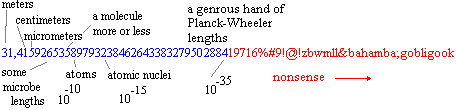
But suppose that a measuring line dropped from heaven and the vessel maker now had a standard length of exactly 10 meter (and God said, "You're using meters now...!") and the vessel maker made the vessel precisely 10 meters in diameter. That means that the circumference of the vessel mentioned in 1 Kings 7:23 was precisely 10 times pi = 31,41592... meters.
Or in words: Thirty-one meters, plus forty-one centimeters, plus five millimeters, plus nine micrometers (that's pretty much the limit of accuracy used in modern engineering), plus a few picometers, plus the width of a few molecules, plus the width of some atoms, plus an electron more or less, plus a couple of the smallest units of length possible in the universe, called Planck-Wheeler lengths.
Smaller detail than that is not possible, but pi goes on! Pi goes on and on to describe smaller and smaller detail, but all of it is fictional and untrue.
Pi is defined as the ratio between C and D of a circle. In 1761 Johann H. Lambert proved that pi is not rational. That means that whatever pi may be, it's certainly not a ratio.
Pi is a paradox and the proof that items that cover an unequal number of dimensions (diameter is 1D; circumference is 2D) are not always compatible.
Any numerical notation of pi is either an approximation or an abbreviation.
Since pi cannot be expressed in numbers, pi is not a number.
Because pi is not a number, the circumference and the diameter of a circle cannot be numbers simultaneously.
The qualities of a circle are in that regard not unlike speed and location of a quantum particle, which can also not be simultaneously known.
The circle is impervious to a numerical approach and it stands as a symbol for scientific insufficiency.
Pi lies. Pi lies by nature of its transcendence, and has no relationship to reality. In fact, by its very nature, the more accurate we represent pi in numbers, the less accurate it represents nature!
Because pi is transcendent, it cannot be written down in a finite string of numbers, not even in the Bible even if the Hebrews had decimal notation, which they didn't. Pi is also not rational and can therefore not be written down as the ratio between two other numbers. Pi cannot even be caught in any finite algebraic equation. In other words, the number pi cannot be fully written down in any way! It leans heavily on the concept of infinity, like the whole number sequence does, and infinity does not occur in nature.
If the Bible were to contain an accurate representation of something that isn't true to begin with (pi), it should use a method that has no precedent in nature and look like an infinite series; like these:
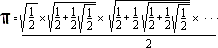

The Bible shows no such thing. When the Bible was written, no such notations existed. And even if it did, it would only have served to display a numerical tower of Babel.
The only practical function of pi, in all its extent, is to test new computers for their speed and accuracy. And the number of pi-digits that we can calculate is a measure for our technological abilities. It used to be fire: the hotter the fire, the more advanced a nation was and the stronger its weaponry and tools were. Nowadays it's computer power.
And even though there's nothing wrong with using computers (we're using one now to show you all these things, aren't we?) the rub lies in the place we give our power to compute in constructing a model of reality around us, and the hope we invest in it that it may someday deliver us from all our shortcomings and failures.
🔼Stairway to heaven
The Titans tried it. The tower builders of Babel tried it. And mathematics tried it too. In the beginning of the twentieth century the cry was heard for the establishment of a bouquet of axioms that was completely consistent and totally able to cover all truths that could flow forth from the axioms. The so-called Hilbert program commenced, with David Hilbert waving the banner and leading an army of mathematical prospectors.
Quoting Keith Devlin's Mathematics; The Science Of Patterns, page 62:
"Any dreams that the Hilbert program could be completed were dashed in 1931, when a young Austrian mathematician called Kurt Gödel proved a result that was to change our view of mathematics forever.[...] There will always be some questions that cannot be answered on the basis of the axioms."
In mathematics it is of crucial importance that we state on which geometry we place our truths. Saying that pi equals 3.1415... works only on a perfectly flat Euclidean geometry (which doesn't exist in nature, by the way). If we work on a Riemannian geometry (that's perfectly spherical; which also doesn't exist in nature) pi is smaller than flat-pi and also varies between smaller and bigger circles on the same sphere. And on a hyperbolic geometry, pi is not even a constant but varies as we travel along a circle. After Gödel it is of crucial importance that our truths go accompanied with the geometry, or theometry, upon which they are stated.
Since math is the language of science, science has pronounced its own incompleteness; there is something beyond the reach of scientific approach. Scientific truth is not equal to absolute Truth. All-encompassing Truth exists beyond the bubble of science and shouldn't be sought in facts and theories.
Math is of a lower order than physical reality and its accuracy is its folly. The big advantage of scientific thought is its accountability; statements can be checked by others using simple rules. But the big disadvantage of science is its incompleteness.
The solution of the 1 Kings 7:23 pi-conundrum reflects perhaps the oldest conflict of all. In the heart of the garden of Eden there were two trees: the Tree Of Life from which Adam and Eve could eat freely, and the Tree Of Knowledge Of Good and Evil. Contrary to common understanding, this latter tree was as perfect as the rest of Paradise and its function was firmly fixed within the large scheme of things. What that function exactly was we don't know, but its fruits were not suited for consumption, lethal when attempted. But before Eve ate, before the fall, hence with her truthful observations intact, she noted that the tree was good for food, and that it was a delight to the eyes and that the tree was desirable to make wise. How this tree was to do this is unknown, but certainly not by having its fruits depended on for food and sustenance.
It's a big step (too big a step) to say that scientists are the harvesters of the Tree Of Knowledge Of Good And Evil, but even if science will achieve her coveted Theory Of Everything, or rather Grand Overall Description, there will always be holes in the story, and science is too leaky a vessel for any Truth-seeker to put much hope in.
Max Cohen was right. It's not the number. It's the syntax. It's what's between the numbers. And now that we have established that numbers in general have no bearing on reality, perhaps we should have a look at how the Bible deals with numbers.