
Psalm 42:7
— Deep cries out to Deep —
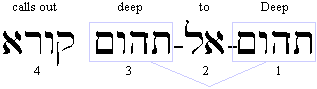
Everybody knows about the panting deer of the opening line of Psalm 42, and many experience the sentiment that gave rise to this image. But few realize the exquisite and valiant choice of words the sons of Korah display, especially in the seventh verse.
Psalm 42 is a dance of fluidic words. Meticulously, the author breaks a continuum, evokes contrasts and has elements congrue into new onenesses.
The word for "deer" comes from a root that generally denotes a protruding or something that stands proudly and quietly: אול ('wl; other derivations are words meaning: belly, leader, porch, ram, door post, terebinth).
Its longing or panting is penciled with the verb ערג (arag), a very unusual word that, judging from equivalents in cognate languages, rather means a bending, declining or even ascending.
Contrary to common interpretation, the image is gentle and still and charged with great tension. The deer emerges from the forest — early morning perhaps; mist in elongated blurs rests nimbly on the grass — and as it stands attention the observer feels its thirst. Slowly the animal stoops towards the flow of water below.
The author yearns to emerge from the throngs of those who challenge his trust in the One he desires. But instead of drinking Him, he drinks his own tears, and all that pours is his own soul within him, descended, like the very water that the deer yields towards. The author's soul is depressed, like the Jordan (means Descender or Descended). That is why he remembers God from the Jordanian low land, but also from the high peaks of the Hermon, and thus he creates the maximum vertical stretch possible from his local perspective. The author fills the entire leap from highest point of the earth to the lowest; the deepest depth, and cries out to the deepest depth after which he was created.
Creation began when the Spirit of God hovered over the waters, and darkness lay on the face of the deep, תהום (tehom), same word. In Romans 8 we read about creation groaning and suffering anxiously from longing for the revelation of the sons of God, and we must recognize that in the private ardor of Psalm 42, the voice of the entire universe resounds, perhaps even as primary intend. But that's far from all.
The Greek word for "cross" is σταυρος (stauros), a noun from the verb ιστημι (histemi), meaning to stand. Romans had the habit of hanging criminals up for everyone to see, which was not uncommon to other cultures (Israel: Deuteronomy 21:23; Persia: Ester 5:15).
However, the distinctive horizontal cross-section, with which a stauros was often but not always equipped, is not mentioned anywhere in Scriptures. We simply don't know whether Jesus was hanged with His arms vertical or horizontal.
A stauros is literally a lifter-upper, and the phrase "Christ crucified" points at His elevation and obviousness, much rather than to the Roman instrument of execution. In the below quote another verb is used, but the intention is the same:
"And I, if I be lifted up from the earth will draw all men to Myself" — John 12:32
In verse 9 of Psalm 42, the author likens God distinctively to the opposite of water: a rock. "The figure of God as a rock becomes typical for the New Testament teachings relative to Christ's person and walk — 1 Peter 2:6; 1 Corinthians 10:4" (say Harris, Archer and Waltke), and our attention is drawn to Jesus Christ. Remarkable, because where the Psalmist states, "I will say to God, my Rock, "Why hast Thou forgotten Me?"," Jesus cried from the cross, "My God, My God, why have You forsaken Me?" (Matthew 27:46).
Dying the way Jesus did is a pretty hard death. There is some debate about His actual posture, but everyone agrees that His arms were stretched, and placed either sideways or straight up. The result of this is that the chest cavity expands and exhaling is made difficult. After a while, breathing is impossible and Jesus' actual cause of death was exhaustion and asphyxia. This makes the report of His dying by Matthew and Mark highly remarkable, if not boldly referential, "And Jesus cried out again with a loud voice, and yielded up His spirit" (Matthew 27:50); "And Jesus uttered a loud cry and breathed His last" (Mark 15:37).
"Jesus, knowing that all things had already been accomplished, in order that the Scripture might be fulfilled, said, "I am thirsty" (John 19:28)." NAS links this to Psalm 22:15. Others to 69:21. But perhaps Jesus thought of Psalm 42:7, and its incredible extent of profundity, and Deep cried out to Deep.