
Revelation 6:8
— The Fourth or Green Horseman —
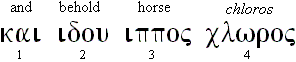
KJV: And I looked, and behold a pale horse
Green: And I saw, and behold, a pale green horse
Webster: And I looked, and behold, a pale horse
Weymouth: I looked and a pale-colored horse appeared
Leidse Vertaling: Ik zag toe, en zie, daar was een vaalgeel paard
Statenvertaling: En ik zag, en ziet, een vaal paard
Luther: Und ich sah, und siehe, ein fahles Pferd
Not a book in the Bible has captured the imagination of the general public as much as the Book of Revelation of Jesus Christ. Angels pouring fire and ten-headed dragons romp about and a fierce, if not bizarre, array of visions are presented at light speed. It's a little odd, therefore, that no translation in existence has colored the fourth horse the way John saw it: green. Green horses, after all, do not exist.
The word is chloros, where our word "chlorophyll" comes from; bright green, grass-green. The same word is used in conjunction with grass in Mark 6:39 and Revelation 8:7, and it's the color of spring, rejuvenation or even re-birth.
The outlook on a personal experience of death may be a bit grim for some, but in nature and even in the material realm, the death of creatures allows next generations to emerge, and it is the prime instrument for growth. Because the cells that make up our bodies live only a few months and are then replaced by fresh ones, we have the ability to grow and heal.
Then there is the issue of balance. There are four horses; the first one is white and the third one is black, like a perfect two-some. The second horse is red and the fourth horse is green, again a perfect two-some.
A few centuries before John the Revelator, the prophet Zechariah also has a vision concerning similar horses, with the exception of the black horse (Zechariah 1:8). One of the three colors the prophet mentions is the Hebrew word saroq, which is commonly translated with either red or brown, and for no particular reason, mind you.
Another derivation of the same root srq is the identical word saroq, which the Abarim Publications Editorial Team unanimously deems the very same word. It means vine or tendrils, and although grapes that hang off a vine may be red, the vine itself is green; bright green, May-green.
Both Zechariah and John saw a bright green horse.
For an excursion in a parallel, which matches the splendid bizarreness of the mother text, click on the green horse below:
