
21. Genesis 1 Explained
— The Chaotic Set Theory —
1 John 5:8
And there are three that bear witness on the earth; the Spirit, and the water, and the blood; and the three are one.
The Chaotic Set
For all kinds of reasons, mankind has been projecting the weirdest tales upon the creation account, and for many reasons more, some elements from the story were blatantly deleted, while others were almost randomly added. Today however, armed with our substantial yet incomplete knowledge of the origins, we are allowed to not only pierce through the heart of the universe, but also that of Scriptures.
A long hard look at Genesis 1 and the sequential Scriptures that explain Genesis 1, reveals the following (in the pages to come we will examine the proof and consequences):
Our world so far develops in three distinct but intimately related self-similar 'periods' that cover the evolution of matter, life and mind. The catch is that these three periods develop according to one single pattern, which is the meta-narrative behind all evolution. Ergo: matter, life and mind are self-similar, and Genesis 1 is the meta-narrative of all development: the scaffold in which the entire universe, from beginning to end, was created.
The Chaotic Set Theory looks at Genesis 1 through the eyes of Chaos Theory, or more specifically, the Mandelbrot Set and the Household Set. Where the Mandelbrot Set consists of marshmallow men inside bigger marshmallow men and the Household Set of little houses within big ones, the Chaotic Set consists of periods within periods within periods.
Identifying the Borders of the Periods in the Biblical Narrative.
When Jesus is asked about the end of the age He likens that particular event to the days of Noah. And He says a remarkable thing: "For as in those days which were before the flood they were eating and drinking, they were marrying and giving in marriage, until the day that Noah entered the ark, and they did not understand until the flood came and took them all away." (Matthew 24:38-39)
There are two peculiar words in this sentence, words that are commonly not very accurately translated. First, the verb that describes the motion 'take away' (...and took them all away) is the Greek verb airo, with which a distinctive upward motion is indicated. The other important word is the one which describes the ignorance of Noah's peers: ginosko, which means to know in a general sense. This verb is usually accompanied with the object of understanding, but not here. And so this line is not about the people not knowing about the flood, but not knowing in general. Jesus states that the intellectual mind commenced in the Noahic flood. And before the flood there was no distinction between animal mind and human mind. The Noahic flood tells the story of how the human mind broke away from the mental symmetry that existed in the animal realm.
This may seem horribly unbiblical but as usual, our intuition leads us astray. There are at least two statements in the Bible that declare a full human- and animal-mind symmetry:
Ecclesiastes 3:18
I said to myself concerning the sons of men, "God has surely tested them in order for them to see that they are but beasts.".
Jude 1:10
But these men revile the things which they do not understand; and the things which they know by instinct, like unreasoning animals, by these things they are destroyed.
From Adam up to Noah tells us the story of the development of life in general (on a complexity-axis, not a time-axis), and life begins in Adam as described in Genesis 2:7. We know this because of Eve it was said that she was the mother of all life (3:20). The Hebrew word for mother comes from the same word from which the word for nation or people is derived. Hence the phrases Mother Babylon and Mother Jerusalem. The phrase 'all life' returns six times in Scriptures and never just mankind is meant (show me). Hence the 'mother of all life' is the biosphere; all living things.
We also know that God created all animals and plants apart from Adam, so there were distinct entities. But there was symmetry.
Adam2:7 is the first living creature but life as a concept or as a principle is introduced earlier in Genesis, namely on the fifth day. Genesis 2:7 reads literally: 'and he became the adam for the life soul'. The particle that means 'for' is left out in translations so that our translations fit our theology. Even in the 1 Corinthians 15:45 quote the particle eis, a particle with the primary idea of motion into or towards a thing, is commonly ignored.
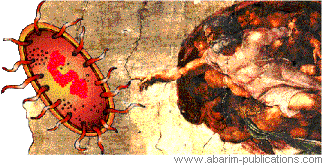
But the truth is that just like the Spirit existed before Jesus emerged in bodily form, so existed life before there were corporeal manifestations.
Very recent research has revealed that all multi-cellular creatures came from one common single-cellular ancestor that lived long ago in a world full of single-cellular creatures. In fact, our ancestor was part of a family that numbered about as many siblings as the Standard Model has particles. And only one begat multi-cellular offspring. (And if you're wondering why our Adam doesn't seem to reflect the image of God, you probably skipped our chapter on the Household Set).
Three major reason to read the periods of the Chaotic Set in Genesis
- The first set of confirmations is provided by indirect references in the sequential Scriptures, such as the ones noted above.
- Second, every realm is heralded by a big flood. The first flood is the great creational flood of Genesis 1:2, after which, we may suspect, matter (and space-time) commenced. The second 'flood' is the Genesis 2:6 flood, after which life began (2:7). The third flood is the famous one, the flood of Noah after which the human mind began to distinguish itself from the animal 'mind'.
- But the most compelling reason is the Name-change of the Creator. In chapter 17 we have already pointed at the importance of names in Scriptures, and the power of the name-change principle. Just like a painter who creates a rose will make a different thing than a sculptor who makes a rose, God called Elohim will create different things than when He is called Yahweh Elohim or Dabar Yahweh.
The Names of God are important because, as is with any name in Scriptures, they are stylized repoussoirs of His activities which define Him at that moment in the Text. For a look at the meaning of (some of) the Names of God click here.
Summary of the Chaotic Set
1 John 5:8
And there are three that bear witness on the earth; the Spirit, and the water, and the blood; and the three are one.
| Realms: | Matter | Life | Mind |
| Biblical coverage: | Genesis 1 to 2:4 | Genesis 2 to 7 | Genesis 8 to Revelation |
| Creator's Name: | Elohim | Yahweh Elohim | Dabar Yahweh |
| Flood: | Genesis 1:2, Spirit moving over the waters | Genesis 2:6, Mist waters the whole ground | Genesis 7-8, Noah's flood |
| Water | The energy from which matter came (E=mc2). |
| Blood | Life. |
| Spirit | Mind addressed by the Word of God, first pre-carnate (from Abraham up to the birth of Christ) then incarnate (from Christ up to now). |
The periods themselves also follow the creation week; every period is like a day of the creation week. The fourth day is the day of Christ incarnate. First as a single human God, then as the Body of Christ; stars, the offspring of Abraham. After all, Christ was 'in the earth' for three days, and then He would restore the Temple in another three.
Notice that the week is like a day inverted. A creation-day starts out with dark (darkness was over the surface), then light (let there be light). The week starts out with light, then dark. The difference is that on a day the elements emerge and need to move towards each other. A week starts out with a light part and the elements of the dark part that follows become a multiple manifestation of the initial light.
It now becomes fairly simple to align the various scientific records with the Creation Week. And doing so we are able to 'predict' the entire rest of the Bible.
Next page: Genesis 1; A week of weeks →