
Quantum Phrases
Elementary ParticlesThe smallest things in nature; particles that can't be divided into smaller things. The entire visible universe is made from only three particles: the Up-quark, the Down-quark, and the electron. | |
| Fermions- named after Mr. Fermi. Fermions are "real" particles. | Quarks - named after curd cheese. Quarks do not occur free but are always bound into Hadrons (see below *). Quarks hold most of the mass of the universe, and store information by the way they are grouped in atomic nuclei (see below **). |
| Leptons - named after the Greek word for 'small' or 'thin'. The famous electron is a lepton, and electrons form a "living" body around the atomic nucleus. With this body, the atom interacts with neighboring atoms. | |
| Bosons - named after Mr. Bose. Bosons are the smallest quantities of the four different natural forces. | Gluons - named after glue. Gluons convey the Strong Nuclear Force that binds quarks into compounds. There are 8 of them, but these 8 can exists in several different states. |
| Photons - named after the Greek word for light. Photons convey the Electromagnetic Force. The electromagnetic force binds electrons to the atomic nucleus, and atoms and molecules together. This force field gives solidity to material (it keeps you from sinking through your chair and on to the center of the earth) | |
| Weak bosons - named after the force they convey, namely the Weak Nuclear Force. There are 3 of them: W-, W+ and Z. Their job is to prowl high energy environments in search of unstable particles to decay. | |
| Gravitons - named after the Latin word for heaviness or weight. Gravitons convey the Gravitational Force, a.k.a. gravity. | |
| * Hadrons Quark Compounds of either 3 or 2 quarks | |
| Baryons - made up of 3 quarks | Protons - named after the Greek word proto, as the proton was the first discovered hadron. Protons consist of 2 Up-quarks and 1 Down-quark, and are so stable that no proton decay has ever been observed. They exist many times longer than the present age of the universe. |
| Neutrons - named after the Latin word neutralis, meaning to belong to neither, or simply neutral. Neutrons consist of 2 Down-quarks and 1 Up-quark, and are stable as long as they are incorporated in a nucleus. Let loose, they live about 12 minutes and then they decay into a proton and an electron. Vice versa, when an electron is squeezed into a proton, the result is a neutron. | |
| Many more Baryons exist, but they are made from quarks that are unstable themselves. These heavy Baryons occur very rarely in nature and when they do, they decay almost immediately after they were born. Heavy guys like this may come about in certain very violent cosmic events. | |
| Mesons - made up of 2 quarks, namely 1 quark and its anti-quark. Mesons are, obviously, highly unstable. | Pions A positive pion consists of 1 Up-quark and 1 anti-Up. A negative pion consists of 1 Down-quark and 1 anti-Down. |
| Many others | |
| ** Atoms Structures consisting of protons and neutrons, which are bound into a nucleus by the strong nuclear force, and electrons bound to the nucleus by the electromagnetic force. The qualities of an element are determined by the number of protons in the nucleus. The number of neutrons follows the number of protons, with some liberty, and an electrically neutral atom has as many electrons as protons. | |||||||||||||||||
| H | Click or hover over the elements for more info | He | |||||||||||||||
| Li | Be | B | C | N | O | F | Ne | ||||||||||
| Na | Mg | Al | Si | P | S | Cl | Ar | ||||||||||
| K | Ca | Sc | Ti | V | Cr | Mn | Fe | Co | Ni | Cu | Zn | Ga | Ge | As | Se | Br | Kr |
| Rb | Sr | Y | Zr | Nb | Mo | Tc | Ru | Rh | Pd | Ag | Cd | In | Sn | Sb | Te | I | Xe |
| Cs | Ba | * | Hf | Ta | W | Re | Os | Ir | Pt | Au | Hg | Tl | Pb | Bi | Po | At | Rn |
| Fr | Ra | ** | Rf | Db | Sg | Bh | Hs | Mt | Ds | Rg | Cn | Uut | Uuq | Uup | Uuh | Uus | Uuo |
| * | La | Ce | Pr | Nd | Pm | Sm | Eu | Gd | Tb | Dy | Ho | Er | Tm | Yb | Lu | ||
| ** | Ac | Th | Pa | U | Np | Pu | Am | Cm | Bk | Cf | Es | Fm | Md | No | Lr | ||
| Molecules Molecules are structures consisting of atoms. If an atom is a letter, then a molecule is a word; even with a limited number of atoms a huge number of molecules can exist. A molecule can be as small as one atom (namely the hydrogen atom), and be as large as to contain billions of individual atoms (DNA for instance). A molecule is the smallest amount of a substance that still has the qualities of that substance. Most items and objects you see around you consist of many different kinds of molecules working together in a kind of electromagnetic symphony. | ||||
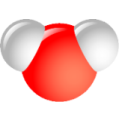 | 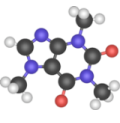 Caffeine | 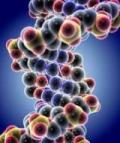 | ||