
Hair in the Bible
— Word Study—
🔼The word Hair
In English the word 'hair' is an orphan. That means that it sits on top of the derivation tree; there's no word or idea in use in the English language where the word hair comes from. But because hair is such a distinct item, the word hair is also a very fertile parent. Everything that is either long or thin or occurs in bristles, is referred to by means of that distinctive word hair. Hence we eat hair-pasta, repair hair-cracks, and grow hair-grass. Expressively, we try to not go against the hair, or get in someone's hair. When, in the morning, one hangs by a hair, we subscribe hair of the dog. And when we let our hair down, we try not to split any.
In Hebrew, however, the word and idea of hair is part of a larger symbolic and verbal superstructure.
The Superstructure of the Bible
The 'superstructure of a text' refers to the natural connection between words and thus ideas that are represented by the words, but with which the text itself not necessarily deals.
Take the words gramophone and microphone, for instance. By looking at these words, even when we don't exactly know what they mean, we can see that they have to do with something from which they both were derived, namely the element 'phone.'
When we realize that 'phone' is the Greek word for sound, we know at once that both items are related to sound, even though the text in which these words appear doesn't talk about sound (i.e. "Bob put the microphone is his pocket, and the gramophone on a shelf").
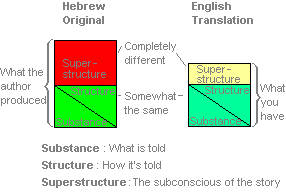
In English the superstructure of a text is usually not very important but in highly poetic and allegorical texts, such as the Hebrew texts of the Bible, the superstructure is an integral part of the total message, and deliberately put there by the author.
The great advantage of translating the Bible into modern languages is that everybody can read it. The great disadvantage is that the intended superstructure, and all its wealth and essential information, is lost.
The Biblical word for hair (as in 'a head full of hair') is שׂער (se'ar). It comes from the assumed and unused root שׂער (s'r), and because it is unused, we don't really know what it might have meant. But we know that it existed because there are other Hebrew words that were derived from that same root.
The word for one single hair is the feminine noun שׂערה (sa'ara), which is used in Biblical expressions such as 'sling a stone at a hair without missing' (Judges 20:16), where the hair denotes the smallest target imaginable, or 'no hair on his head will fall to the ground' (1 Samuel 14:45), where a falling hair denotes the least bit of harm that may happen to someone; a quantum of pain, so to speak. And now that we know that hair is a physical manifestation of a mental quality, we are at once attracted to Solomon's celebrated saying "he who increases knowledge increases pain" (Ecclesiastes 1:18).
In a few rare occasions the word שׂער is used as an adjective: Genesis 27:11 and 23, both describing Jacob trying to emulate Esau. It has been suggested that the Jacob and Esau cycle reflects the interaction of various humanoid species.
The defense of this theory comes from the obvious difference between Jacob and Esau. Esau is hairy and not too clever. Jacob is smooth (see the study of hair-antonyms below) and easily outwits Esau but still stays afraid for any bodily harm that he might inflict on him. Jacob is even so sophisticated that he becomes the first recorded geneticist, as he successfully interferes with the reproduction of cattle. His undecided battle with the angel argues again for his mental capacity, and his building himself a house and booths for his cattle has been taken by many to denote the transition between the old nomadic lifestyle and the more modern ways of animal husbandry (Genesis 33:17).
Of course, this theory is rejected by those who on general principle reject the theory that we humans once had a few sibling species, as well as by those who reject the theory that very old data can be preserved in a culture's collective memory. But that's beside the point right now.
🔼Goats and such
Another derivation of our mysterious root word is the noun שׂעיר, male goat or buck (שׂעירה denotes the female). If the meaning of the mystery root is indeed 'to be hairy,' a goat was known as a hairy one. But that seems a bit odd since a goat is not hairier than any other animal, and certainly not the hairiest of the herd animals. For us the most important difference between goats and sheep, however, is that goats 'are generally more alert than sheep' (according to Dr. Clive Dalton). That means that a shepherd would keep an eye on his goats more than his sheep, to get an early indication that danger approached.
A large majority of occurrences of this word deals with the goat as sin offer (Leviticus 4 and 16). In Daniel 8:5 the hairy he-goat returns as symbol of Javan (Greece; the culture that taught the world philosophy and math and all that). This word also serves as the name Seir, the nickname and place of residence of our friend Esau.
Four instances of the word שׂעיר are a bit disputed, although the dispute has been largely settled. In the texts Leviticus 17:7, 2 Chronicles 11:15, Isaiah 13:21 and 34:14 the King James Version translated the word שׂעיר with demon or satyr. Harris, Archer and Waltke's Theological Wordbook disdainfully remarks that 'there is no need to go to this bizarre translation. NIV translates the first two instances as "goat idol," the last two as "goat" and "wild goat." The NAS has something similar but uses "satyr" in 2 Chronicles 11:15.' And places a footnote 'demon' under Isaiah 34:14, we would like to add.
The feminine noun שׂערה (se'ora) denotes barley. The connection between hair and this 'bearded' grain seems obvious, but it should be noted that barley was typically used as fodder for animals (1 Kings 4:28), and by people only consumed by the very poor (Ruth 2:7, Jud 7:13, John 6:5). Barley, remarkably, also played a part in the jealousy trial, 'for it is a food offering of jealousy, a food offering of memorial, a reminder of sin' (Numbers 5:15). Since the barley harvest takes place a few weeks before the wheat harvest, the barley harvest signified the time of the Feast of First Fruits, a.k.a. Feast of Weeks, and Feast of Pentecost (Numbers 28:26-31; Ruth 1:22; 2:23; 2 Samuel 21:9-10)
That the meaning of the root is probably not simply 'to be hairy' but something upon which the symbolic meaning of hair was grafted becomes clear by the derived verb שׂער (sa'ar), to be very afraid. Both HAW and BDB suggest a meaning of 'to bristle with terror,' but that seems highly artificial. This verb occurs in the following four texts:
- Job 18:20, "those in the West shall be amazed at his day, and those in the East were seized שׂער (horrified or hairified?)."
- Jeremiah 2:12, "Be amazed, O heavens, at this, and be שׂער (horrified or hairy?), be utterly desolated, declares YHWH." (Even with all anthropomorphic lenience and poetic license, to pin bristling as an attribute to the heavens is really rather daft.)
- Ezekiel 27:35, "All the inhabitants of the coastlands are appalled at you, and their kings are שׂערו שער ("hairy and hair" or "horrified and horror") trembles their faces." (Hebrew repeats a word to present an emphasis, but in this case a correct rendering would be: and their kings are horrified; horror trembles on their faces).
- A similar message occurs in Ezekiel 32:10.
🔼Intermediate Conclusion
It seems that the most basic meaning of our root is one of intense awareness, with undertones of fear or reverence and the wish for self-preservation. Hence the goat is not 'the hairy one,' but 'the aware one,' or rather, 'the one who makes aware' and serves in the sin-offering ritual as symbol of awareness of sin, which parallels the later doctrine of forgiveness via confession, which obviously requires an awareness first (1 John 1:9). The demon-translation that the KJV proposes may actually be rooted in a forgotten tradition that still linked awareness to goats. Demons, after all, do nothing but convince people of their sin; the word diablo comes from the Greek word for accuser. This forgotten tradition may even have helped the Knights Templar choose their goat-headed Baphomet.
Barley is not a 'bearded' grain but a produce that made aware of the time of the year, and reasons for gratitude. It's typical that the Holy Spirit was poured out on Pentecost, and that a strong wind was heard (Acts 2:1-2). We've already noted a connection between hair and certain storm-words and we'll have a better look below. The killer-cake that rolled into the Midianite camp was typically made of barley (Judges 7:13), and Gideon's campaign was specifically designed to cause the kind of fear that is also noted in the above cited texts (Job 18:20, etc.).
🔼More words
Words are grouped by roots, and if a word-group is spelled the same as some other word-group but obviously means something different, we assume that the two come from different roots. The word שׂער (sa'ar), hair, is generally assumed to come from one of four different roots, but now that we are disputing the meaning of שׂער, we are inevitably disputing the sole reason why it is thought that there are multiple roots that look the same but aren't.
Verbal Roots
The vocabulary of a language consists of words. Many of these words have to do with each other; they are derived from the same root (like the words 'companion,' 'company,' 'compare,' 'compassion' and 'compatible'). And sometimes there are words that are identical but have nothing to do with each other (that's called a homograph; like: "Let's desert the army in the desert", or "Dashing Bob wound up with a gaping wound").
Since we have no sound recordings from the times in which the Bible was written, we have to look at words and guess whether they come from the same root or not. If they mean something similar, they might be from the same root, but if they mean something completely different, they're probably of different origin.
It helps when there are equivalents in cognate languages. For Hebrew that's Aramaic, Arabic, Assyrian and some others. But an equivalent in a cognate language doesn't necessarily prove that our word and its equivalent are the same.
Take the word 'worst' for instance. In Dutch (which is a cognate of English) it means 'sausage,' same as the German Wurst. But in English 'worst' denotes the superlative of bad (bad, worse, worst). In Dutch however, there is the word saucijs, which is a specialized word for ground pork meat with herbs. Obviously, the English word 'sausage' is much more general than the Dutch word saucijs, and should be translated to Dutch with worst, not saucijs. Yet it is obvious that both words 'sausage' and saucijs come from the same root, namely the Latin word for salt.
Hence we know right off the bat that sausages and the saucijs are salty.
🔼שׂער Root 1
There are four accepted roots that are spelled שׂער. The first one has been expounded at length above, and where everybody thinks that it basically means 'hair,' the Abarim Publications Editorial Team finds more support for a meaning of intense awareness.
🔼שׂער Root 2
Root number two is the verb שׂער, meaning to sweep away, whirl away. There's no connection between to be hairy and to be swirled away, but there certainly is one between being intensely aware and being swirled away. The verb occurs four times:
In Psalm 58:9 it occurs opposite the verb 'to feel,' in the enigmatic line, "Before your pots can feel the fire of thorns, he will sweep it/them away."
Psalm 50:3, "Fire devours before Him, and it is very stormy around Him."
Job 27:20-21, "Terrors overtake him like a flood; a tempest steals him away in the night. The east wind carries him away and he is gone, for it whirls him away from his place. For it will hurl at him without sparing; he will surely try to flee from its power."
Daniel 11:40, "And at the end time the king of the South will collide with him, and the king of the north will storm against him..."
This verb yields two similar derivatives, one masculine (שׂער) and one feminine (שׂערה) both meaning storm:
Isaiah 28:2, "as a storm of hail, a tempest (שׂער) of destruction."
Nahum 1:3, "In whirlwind and storm (שׂערה) is His way."
Job 9:17, "For He bruises me with a tempest (שׂערה)."
The Bible writers didn't have the benefit of dictionaries and spelling standards, which sometimes resulted in an interchanging of letters that sounded the same, or at least that's what we assume. An example of this are the letters ש (shin/sin) and ס (samekh), that both probably sounded like our letter 's'. Later the ש itself breached into two different letters, namely שׁ (shin, with the dot to the right, sounds like 'sh') and שׂ (sin, with the dot to the left, sounds like 's'). That these differences in pronunciation had to do with different dialects that were spoken in different regions is illustrated by the style of writers from those regions. The book of Judges tells of a speech test based on the word shibboleth (a regular word that either means flowing stream — Isaiah 27:12 — or head of grain — Ruth 2:2). Those who pronounced this word as שׂבלת (sibboleth) spoke with the Ephraimite dialect.
Hence, when we are looking at a word that contains a שׂ , שׁ or a ס, it's always interesting to look at possible alternate spellings. It so happens that our root 2 has a such a by-form:
The verb סער (sa'ar) means to storm, whirlwind, tempest, rage, and is obviously a by-form of שׂער (sa'ar). The curious thing about this word, however, is its remarkably frequent usage in denoting metaphorical storms; 'storms' that describe anger, fear, the wrath of the Lord or full-fledged theophanies. Since this word tends to be used 'metaphorically' in earlier texts and literally in late text, we propose that the original meaning of the verb had to do with human passion, and that the usage to describe meteorological storms is in fact the metaphor.
The verb סער is used in: 2 Kings 6:11, "The heart of the king of Aram stormed"; Isaiah 54:11, "Afflicted one, stormed one" (said of Jerusalem); Hosea 13:3, "they will be like chaff stormed off the floor and as smoke out the window" Jonah 1:11, 13, "for the sea was becoming increasingly stormy" (tied to 'extremely frightened,' v10); Habakkuk 3:14, "They stormed in to devour me" (tied to 'their exultation'); Zechariah 7:14, "And I stormed them away on all the nations..." (describes the Diaspora);
The derived masculine noun סער occurs in these texts: Psalm 55:8, "I would hasten to my escape, from the rushing wind, from the storm"; Psalm 83:16, "so pursue them with your tempest, and frighten them with your storm"; Jeremiah 23:19, "Behold, the storm of the Lord has gone forth in wrath, even a whirling tempest; it will swirl down on the head of the wicked." Jeremiah 25:32, "Behold, evil is going forth from nation to nation, and a great storm is being stirred up from the corners of the earth." (Here the storm either equals the evil of nations, or God's response to it). Jeremiah 30:23, "Behold, the tempest of the Lord. Wrath has gone forth, a sweeping tempest; It will burst on the head of the wicked." Amos 1:14, "... and a storm on the day of tempest" (The latter word comes from a verb that means 'to come to an end', see the box). Jonah 1:4, "...and there was a great storm on the sea." Jonah 1:12, "for now I know that on account of me this great storm is upon you." (These last two instances seem to cover meteorological storms, but, as v12 indicates, they're obviously physical manifestations of the wrath of the Lord.)
The feminine noun סערה (se'ara) means windstorm or whirlwind, and is used similarly to the verb and the masculine noun.
Other storm/wind words:
The Bible's most common word for wind is also the word for spirit: רוח (ruah). The root ריח (riah) means to breathe a fragrance/odor, and derivation ריח (reah) means scent, aroma. If this word is used to mean wind it generally denotes a pleasant breeze. With adjectives, however, this ruah may become very powerful, for instance during Elijah's theophany (1 Kings 19:11).
The word סופה (supa) is used in Isaiah 5:28 and Hosea 8:7 to mean storm wind. It strangely enough comes from the verb סוף (sup), meaning come to an end, cease. This kind of storm was known as the end-maker, probably of crops and houses. The verb even looks like a construct with as base the verb ספה (sapa), sweep away, destroy, consume (although none of the sources reports this connection).
Only used in Psalm 55:9, the word סעה (sa'a) means to rush. It is used as a quality of the word רוח (ruah) wind, in close proximity of the word סער (sa'ar), storm (see text to the left).
The word שׁאוה (sha'awa), storm, only occurs in Proverbs 1:27, in close proximity to סופה. It may come from a verb meaning make a din, but it may also come from a verb that means to ruin or devastate. This storm was known either as the noise-maker or as the devastator.
The noun רעמה (ra'me), thunder, comes from the verb רעם (ra'am), to thunder. In Job 39:19 God insinuates that He clothed a horse's neck with it.
Most notable instances are the whirlwind in which Elijah ascends (2 Kings 2:1, 11), and the whirlwind that precedes Ezekiel's theophany (Ezekiel 1:4). Out of this whirlwind God speaks to Job (Job 38:1, 40:6), and Zechariah predicts that the Messiah will march in the whirlwinds of the south (Zechariah 9:14).
🔼שׂער Root 3
Root number three is the verb שׂער and nobody knows what it means. It's been deemed a separate root because its sole Biblical usage is at odds with the traditional meaning of any other the other שׂער-roots. The text where this 'new' root occurs is Deuteronomy 32:17, the Song of Moses: "They sacrificed to demons who were not God, to gods whom they did not know, new ones who came lately; your fathers had not שׂער them."
Suggestions on how to translate this peculiar verb range from 'dread' (NAS, Green, others) to 'had acquaintance,' 'revere with awe,' and 'shudder before' (BDB). Here at Abarim Publications we have less trouble with this verb. It is of course a straight-through-the-gate instance of our primary definition: intense awareness. This third root is not a root but an application of root 1.
🔼שׂער Root 4
Root number four is the assumed and unused root שׂער of the plural derivation שעירים (se'irim), apparently denoting some kind of precipitation. Like the previous 'root' it is used only once. And it's used in close proximity to the unique instance of the previous 'root,' again in the Song of Moses. All the more reason to be suspicious:
Deuteronomy 32:1-2 reads, "Give ear, O heavens, and let me speak; and let the earth hear the words of my mouth. Let my teaching drop as the rain, my speech distil as the dew, as the שעירים on the fresh grass and as the showers on the herb."
This exquisite line consists of an intricate symmetry, about which is much to say. But it is obviously primarily permeated with images of precipitation. Since Israel was an agricultural society, rain in all its forms stood at the base of prosperity. As such it was held indistinguishable from wisdom, knowledge and revelation, and this becomes most clear by the word מורה (which, by the way, isn't used in Deuteronomy 32:1-2).
The word מורה (moreh) means early rain (as used in Joel 2:23 and Psalm 84:7). This word — inclusive later added consonants — is identical to the word מורה (moreh), which means teacher. Both words come from the verb ירה (yara), throw, cast or shoot. This verb is also used to describe shooting arrows (2 Chronicles 26:15, see also Ephesians 6:16). Another derivation of this root is the word תורה (torah), Torah, meaning Law. The name Jerusalem may have reminded the Hebrews of this verb, and that's maybe why they didn't change it when they conquered it...
The verb ירדּ (yarah), to be afraid (only used in Isaiah 44:8), is identical to ירד (yarah), save for the dot in the heart of the last letter. That dot is called a mappiq and it serves to indicate pronunciation. Even though both words end up being pronounced the same, the dot suggests that they are different words. However, HAW admits that this word probably comes from ירא (yare'), fear, be afraid, revere. And about the identical word ירא (yare), means to shoot or pour (2 Chronicles 26:15, 2 Samuel 11:24, Proverbs 11:25) HAW states that it is 'doubtless a by-form of' ירה (yarah). Go figure.
The word מטר (matar) means rain; the verb מטר (matar) means to rain. HAW states, "Rain is never to be taken for granted by mankind; it comes from the hand of God (Psalm 147:8, Job 5:10, 28:26) in amounts proportional to the spiritual condition of the inhabitants of that land," (Deuteronomy 11:10-18, Amos 4:7).
טל (tal), dew, comes from the assumed root טלל (tll). Apart from the regular observations of dew, dew yielded manna after it evaporated (Exodus 16:13-14), is compared to the king's favor (Proverbs 19:12), instructions (Deuteronomy 32:2), brotherhood (Psalm 133:3), prosperity (Job 29:19), and the remnant of Jacob among the people (Micah 5:7). The identical root טלל (talal) means to cover over (Genesis 19:8, Nehemiah 3:15).
רביבים (rebibim), copious showers, comes from the verb רבב (rabab), become many or much. The identical verb רבב (rabab) means to shoot and, like the verb ירה (yarah), is used to denote the action of archers (Genesis 49:23).
Rain in all its forms made the Hebrews think of God's blessings or instructions. If we take the word שׂער to mean some kind of rain, it may very well be taken from our basic meaning of intense awareness. Root 4 is also not a root but may in fact stem from the words generally grouped under our root 2.
🔼More alternative spellings
We already looked at the alternative spelling סער, where the שׂ was replaced by ס. In some cases, there is also a clear correlation between words spelled with a שׂ and those spelled with a שׁ (although these two letters have specialized so much that often these semi-similar words are really quite different; so, caution is in order).
The form שׁער (sha'ar) is associated with three roots:
Root 1: שׁער (sho'ar) is the assumed root of שׁער (sha'ar), gate (in the sense of a bustling center of commerce, government and court — see our remarks on Samson above). Another derivation is שׁער (sho'er), gatekeeper/ porter.
Root 2: is the verb שׁער (sha'ar), calculate, reckon (Proverbs 23:7) which may have to do with the activity pursued in the gate. Derivation שׁער (sha'ar) means measure (a hundred fold; Genesis 26:12).
Root 3: שׁער (sh'r ), the assumed root of words such as שׁער (sho'ar), horrid, disgusting (Jeremiah 29:17); שׁערורה (sha'arura), horror, appalling (Jeremiah 5:30, 23:14); שׁערוריה (sha'aruriya) or שׁערורית (sha'arurit), horrible thing (Hosea 6:10, Jeremiah 18:13). There seems to be some relation between this root and verb שׂער (sho'ar), to be very afraid/ horrified.
🔼Antonyms
To understand something, it may be beneficial to study the opposite. Hair itself doesn't have an opposite, but hairy is the opposite of bald or hairless. There are a few words in the Bible that deal with this.
The smoothness of Jacob is denoted with the word חלק (halaq), and comes from yet another root-twin, namely חלק (halaq). Root חלק (halaq), from which our word supposedly comes, means to be smooth or slippery. This word is sometimes used to denote slippery stones or bald mountains but most often to denote flattery and slander. The other root, חלק (halaq), denotes sharing, dividing or apportion, mostly of plots of land.
There are at least two instances in which HAW suggests that a derived word was placed under the wrong root. In many translations Hosea 10:2 speaks of a 'divided' heart but probably better would be a 'slippery' heart. And in 1 Samuel 23:28 occurs the name Sela-hammahlekoth, and the question is whether this denotes a place called Slippery Rock (yes says BDB; probably not, says HAW) or Rock Of Divisions, as some others have it, or Rock Of Escapes (after an Akkadian root meaning to escape).
It seems as if our word for Jacob's smoothness would fit right under the first root, but at second glance this root emphasizes poor footing and not some kind of exterior. The opposite of Jacob's smoothness is Esau's hairiness, but the opposite of a slippery rock or a slippery tongue is by no means a hairy rock or a hairy tongue. The opposite of a slippery rock is a big flat solid boulder, and the opposite of a slippery tongue is a tongue that speaks truth. It seems much more likely that the word for Jacob's smoothness comes from the other root, and that it refers to Jacob's few islands of hair in contrast to Esau's full coat.
Another hairy-antonym is the Bible's regular word for bald or baldness: קרח (qerah), and this word occurs without exception in negative contexts. Baldness could be deliberate, as a permitted sign of mourning (Micah 1:16) or as a forbidden sign belonging to an rivaling religion (Jeremiah 9:23).
Baldness could also be involuntary and if it wasn't accompanied by rashes of any kind, the person was clean (Leviticus 13:40-42).
🔼2 Kings 2:24 — Baldhead! Baldhead!
Assuming that holiness also brings about a certain forgiveness for a child's foolishness, the horrible scene in which forty-two young boys are torn apart by bears after they shouted 'baldhead' to Elisha (2 Kings 2:24) can only be explained by the metaphorical meaning of baldness. We've suggested that hair stands for intense awareness, specifically about God's wrath or revelation (which makes the shaving of hair a logical response to grief). Since baldness usually occurs in aged men, who also may show signs of a slipping mind, the kids were basically stating that Elisha was dementing. Specifically, since they used the word 'go up,' it seems likely that they expressed an unbelief that Elijah had 'gone up' to heaven in the whirlwind.
Elijah's ascension was witnessed by Elisha but also by fifty prophets from Bethel and Jericho, who had even predicted this twice (2:3 and 5). Still, when it had happened, even the prophets could not believe it and demanded that they go search for Elijah. It seems likely that they couldn't clearly see what was going on in the distance, and perhaps they didn't even see the chariot of fire (the same thing happened to Paul, after all — Acts 9:7). Their adamancy ashamed Elisha (2:17) and perhaps because of two reasons. First of all, it is always sad to see men of the cloth unable to believe a miracle, but secondly, the authority of Elisha came from Elijah and was only valid if Elijah was actually gone.
Only after three days of searching the prophets reluctantly gave up, but not before asking Elisha for a demonstration of his powers (2:19). As Elisha finally went on his way, the children of Bethel showed up and reflected the unbelief that was rampant in the town. Possibly because even heavenly powers can be obstructed by unbelief (Matthew 13:58, explained by texts such as Romans 1:16 and Ephesians 2:8), God intervened and destroyed that generation. The point was made, and Elisha became one of the most powerful men Israel had ever seen.
The word qerah (baldness) returns as the name of Korah, who descended live into Sheol for demanding from Moses that he too could draft law. It's improbable that Korah's parents named him Baldie at birth. This name was probably pinned on him after his insurrection, which all the more argues our interpretation of the verbal element of hair.