
John 3:16
— Monogenes —
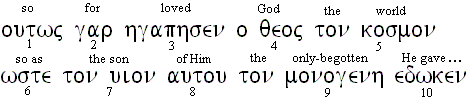
Ten words. That's all it takes to exclaim the greatest event that ever occurred. Perhaps it's even greater than creation itself. John 3:16 reports the merger of Creator and creation into something that may have been the very reason for everything to have come into being. Let's have a look.
All but one word in this text are pretty straight forward. Word number 3 comes from agape, the general love exhaustively excavated by Paul in 1 Corinthians 13:1. Word 5 is our word cosmos, except that this Greek word kosmos is also used for earth and even its human culture. But the big hinge is the word monogenes (our word 9).
Some demand that monogenes means "the only one born," but that assumption is easily neutralized by rattling off the Sons-of-God list:
🔼Sons of God:
The Pre-flood Pack — Genesis 6:2
Israel — Exodus 4:22
Angelic Earth Patrol — Job 1:6
Peace makers — Matthew 5:9
The resurrected — Luke 20:36
Those led by the Spirit of God — Romans 8:14, 8:19
Those who have faith in Christ Jesus — Galatians 3:26
And of course Jesus:
🔼Jesus is the Son of God according to:
Satan (indirectly yes, but he was tempting, not inquiring) — Matthew 4:3
Two demoniacs — Matthew 8:29
The disciples — Matthew 14:33
The crucifying centurion — Matthew 27:54
Unclean spirits — Mark 3:11
Jesus Himself — Luke 22:70
Jesus again, about Himself in the third person — John 3:18, 5:25
John the Evangelist — John 20:31, 1 John 4:15, 1 John 5:5, 1 John 5:10, 1 John 5:13, 1 John 5:20.
A traveling Ethiopian — Acts 8:37
Saul (Paul) — Acts 9:20, Romans 1:4, 2 Corinthians 1:19, Galatians 2:20, Ephesians 4:13, Hebrews 4:14, Hebrews 6:6, Hebrews 7:3, Hebrews 10:29.
🔼Jesus is not the only monogenes in the Bible:
In Hebrews 11:17 the word monogenes is used to describe Abraham's son Isaac, the younger brother of Abraham's first born son Ishmael, and proves that monogenes cannot mean "only-begotten."
NT texts containing the word monogenes, and which are not about Jesus:
Luke 7:12
...the only son of his mother...
Luke 8:42
...for he [Jairus] had an only daughter...
Luke 9:38
...for he is my only boy...
Hebrews 11:17
...offering up his only begotten son (Isaac)...
The solution lies in the second segment of the compound: the word genos, where our words gene and genus come from. It denotes a class or stock, much rather than a simple generation, and see our lengthy article on this noun and its parent verb γινομαι (ginomai).
In most cases, the mentioned monogenes children are only children and by being the only one, one easily becomes a class on one's own. But in the case described in Hebrews 11:17, and also in the case of God's sons, it becomes evident that when more than one child is "generated," there may be one among them who again forms a totally new sub-class. Such is the case with Isaac and also Jesus, the only son of God who is said to be monogenes, and also the only one of whom it was said that He was both fully human and fully God, and that He lived on earth and in heaven simultaneously. Was he both? Both ordinary human and ordinary God?
When scientists were trying to understand the essence of light (to which Jesus compares Himself) they did some tests to reveal whether light was waves or particles. Much to their dismay, some tests proved beyond the shadow of a doubt that light was waves, while other tests proved beyond the shadow of a doubt that light was particles. Battles were waged and many spent their breath trying to convince others of something that didn't exist. Light was both particle and wave, and that's why it was neither; it was a completely new class and comparable to nothing. On top of that, it was discovered that light always travels with the same speed; you can't slow it down or make it hurry. And if that wasn't weird enough, it appeared that at that light speed, all distances became zero and time froze to a standstill. That means that at light speed, there are no meters and no second and certainly no meters-per-second and the speed of light is not a speed! In fact, if we define space as that place where all things that have a size live, and time as that process that makes sure that not everything happens at once, then we can say that light sits on the edge of space-time and is both part of it and not!
Then when we realize that light consists of photons, which are the units of energy and everything that exists in space-time comes from energy, and also that atoms are held together into objects and planets and stars by photons, the following texts may help understand the reader why Jesus is so very monogenes:
John 8:12
I [Jesus] am the Light of the world...
Colossians 1:16-17
For by Him all things were created, [...]. All things have been created by (or: through) Him and for Him. And He is before all things and in Him all things hold together.